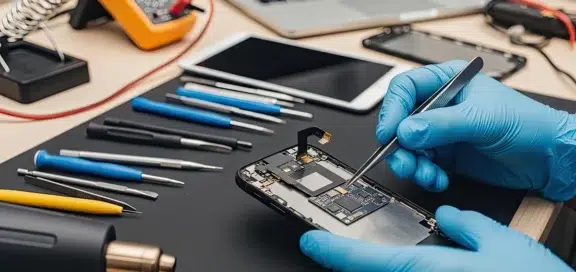

The new right to repair grants consumers the right to have certain products repaired. The aim is to strengthen the circular economy. After all, a product that is repaired does not have to be thrown away and replaced, thereby saving resources.
However, these consumer rights are accompanied by obligations on the part of the manufacturers and retailers of the products in question.
Repairability of products
The right to repair applies initially, in particular, to small appliances and household goods such as smartphones, washing machines and fridges. The hardware and software of products must not be designed in such a way as to make repair impossible. In the case of smartphones, for example, it must be possible to replace the battery without damaging the device. This may require changes to the product design.
Under the new German law, reparability will in future form part of the standard characteristics of a product, with the result that a product which cannot be repaired is deemed to be defective. However, reparability may be excluded in contracts between businesses. This should also be possible through general terms and conditions.
In the case of contracts between businesses and consumers, however, any deviation from the requirements regarding reparability may only be agreed subject to strict conditions.
Spare parts and tools
To enable repairs, manufacturers must make spare parts and repair tools available and offer them at a reasonable price that does not deter consumers from having repairs carried out.
How long spare parts and tools must remain in stock depends on the product in question. For smartphones, for example, spare parts such as batteries, displays or speakers must be available for at least seven years. This period begins the moment production of the model is discontinued (and not, for instance, at the time of its market launch).
For domestic washing machines and tumble dryers, spare parts such as motors, pumps, shock absorbers and springs must even be available for ten years. This regulation is intended to ensure that the right to repair applies throughout the entire typical lifespan of the products concerned. For manufacturers, this may necessitate the maintenance of stock.
Extension of the warranty period
In future, the trader must inform the consumer, before carrying out the remedial work, that the warranty period will be extended once by twelve months in the event of defects if the consumer opts for repair rather than replacement.
For the duration of the repair, the trader may provide the consumer with a replacement item free of charge.
There is also the option of using a standard European form for repair information.
Further changes
If the consumer opts for a repair, the trader must carry out the remedial action within a reasonable period and without causing significant inconvenience to the consumer. It is not yet clear what exactly constitutes ‘reasonable’ periods and ‘significant inconvenience’. This will likely only become clear through future case law.
If the manufacturer is established outside the EU, its repair obligations fall on its authorised representative within the EU. If there is no authorised representative, the obligations fall on the importer; and if there is no importer either, the obligations fall on the distributor of the goods.
Conclusion
The new right to repair imposes an obligation on manufacturers to design their products in a way that allows for repair. This may require changes to product design. The fact that spare parts and tools must remain available for several years even after production has ceased may lead to the need for stockholding. The repair information form presents new bureaucratic challenges.
Key points in brief
- Products must be designed to be repairable
- Spare parts and tools must be made available for a specified period
- A repair can extend the warranty period by 12 months