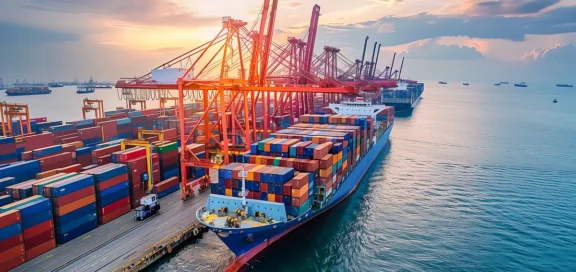
This opens up an attractive growth market for companies. At the same time, regulatory requirements are increasing significantly. Defence logistics is not a business of opportunity, but a strategic market entry with high regulatory requirements.
Defence Logistics as a structural growth market
The defence logistics market is growing rapidly. A significant proportion of defence expenditure is already allocated to transport, storage, maintenance and support services. At the same time, the need for resilient, multinational integrated supply chains is increasing.
For logistics companies, this means that demand is structural, not cyclical. Those who position themselves early secure access to long-term and strategically relevant business relationships.
Market entry: High barriers to entry rather than rapid scaling
Access to the defence market requires time, capital and organisational maturity. Practical experience shows that establishing relevant business units can take several years.
Typical requirements include:
- Certified IT and information security (e.g. ISO 27001)
- Security and reliability checks on personnel
- Organisational structures capable of safeguarding classified information
- Proof of robust supply chains and available capacity
Added to this is de facto protection of market access: established providers are given preference, whilst new market entrants must first build up trust and references.
The decisive shift: from price to trust
In the defence sector, the assessment of commercial bids is undergoing a fundamental shift. It is not the price that determines actual integration into security-relevant supply chains.
The following factors are particularly decisive:
- Operational availability and responsiveness
- Transparency and control throughout the supply chain
- Stable and verifiable corporate structures
References, security standards and organisational resilience are regularly given at least equal weighting, and often even greater weighting, than price.
The first contract is often the decisive step towards sustainable market access.
Legal implications for logistics companies
Entering the defence logistics sector brings about a significant shift in legal requirements. Alongside operational issues, regulatory and structural risks come to the fore.
- Export controls and sanctions
Supply chains involving third countries are subject to intensive regulatory scrutiny. Breaches not only lead to sanctions but also regularly result in exclusion from further contracts. - Contract drafting and liability
Long-term contracts with high availability requirements necessitate a precise definition of service disruptions, escalation mechanisms and liability regimes. Traditional logistics contracts often fall short in this regard. - Compliance and due diligence
Ownership structures, subcontractors, IT security architecture and internal control systems must be designed to be transparent, verifiable and robust. - Enforcement of claims
Complex supply chains increase the likelihood of performance disruptions and multi-party disputes. In international contexts, the question of economically viable enforcement of claims then regularly arises.
For the economic and strategic aspects of litigation financing in complex international supply chain disputes, see our blog post from November 2025. - Supply chain resilience
The ability to maintain performance even under crisis conditions is becoming a key legal and economic benchmark.
Conclusion
Defence logistics offers significant economic opportunities, but is not a market for short-term opportunities. Access requires a structured, legally sound and organisationally robust setup.
Companies that invest early in compliance, contract structure and supply chain resilience will become a permanent part of these new value chains. For all others, access remains structurally limited despite rising demand.
Key points in brief
- Defence logistics is a long-term growth market with high barriers to entry.
- Trust, compliance and resilient supply chains are crucial – not price.
- Legal preparation is the key to sustainable market access and risk management.